Notice: Function _load_textdomain_just_in_time was called incorrectly. Translation loading for the skt-templates domain was triggered too early. This is usually an indicator for some code in the plugin or theme running too early. Translations should be loaded at the init action or later. Please see Debugging in WordPress for more information. (This message was added in version 6.7.0.) in /home/vsmconsultingco/public_html/wp-includes/functions.php on line 6131

Notice: Function _load_textdomain_just_in_time was called incorrectly. Translation loading for the forminator domain was triggered too early. This is usually an indicator for some code in the plugin or theme running too early. Translations should be loaded at the init action or later. Please see Debugging in WordPress for more information. (This message was added in version 6.7.0.) in /home/vsmconsultingco/public_html/wp-includes/functions.php on line 6131
ROI – VSM Consulting

Psychometric Assessment Return on Investment (ROI)

Save Time

Get the best fit candidate the first time around

Avoid Dissapointment

Avoid poor performing staff or an ineffective manager

Save Money

Avoid the costs associated with re-recruiting

Schmidt & Hunter (1998) Research

There are three main points to consider:

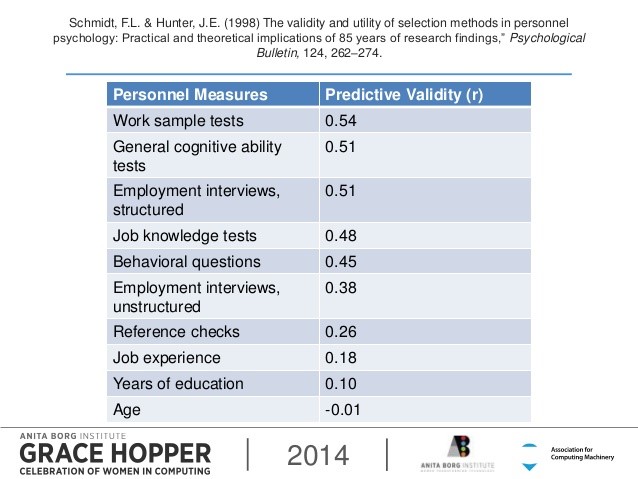
The predictive validity coefficient of an assessment is directly proportional to the practical economic value of the assessment method (Schmidt & Hunter, 1998). This is because increased predictive validity leads to substantial increases in employee performance, including increased outputs, the increased monetary value of those outputs and increased learning of job-related skills (Schmidt & Hunter, 1998).


General mental ability (GMA) (intelligence or cognitive ability) tends to be the most valid predictor of job-related performance, but many other measures also contribute to the validity of the selection process, such as personality traits, structured interviews, job knowledge and work sample tests (Schmidt & Hunter, 1998). However, research evidence for the validity of GMA measures for predicting job performance is stronger than that for any other method (Schmidt & Hunter, 1998). It is the best predictor of the acquisition of job knowledge on the job and of performance in training programmes (Schmidt & Hunter, 1998).

The predictive validity of various selection measures:

GMA is considered the primary measure for personnel hiring decisions, but if used in conjunction with other personnel measures as supplements to GMA, these measures serve to increase the predictive validity of job performance over the .51 that can be obtained by using only GMA (Schmidt & Hunter, 1998). This incremental validity translates into incremental utility or an increase in practical value (Schmidt & Hunter, 1998). Since validity is directly proportional to utility, the percentage of increase produced by adding a second, third, fourth measure is also the percentage increase in practical value (Schmidt & Hunter, 1998).


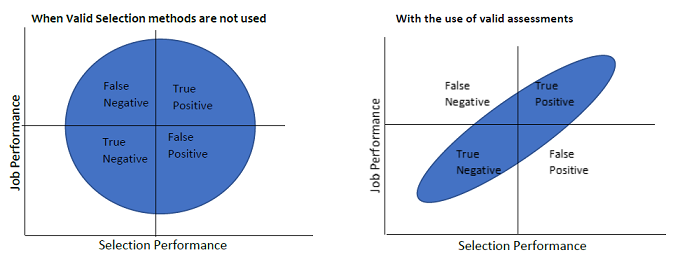
Reducing the odds: The use of psychometric assessments increases the validity and reduces the margin of error which is involved in any selection process. There will always be a proportion of false positives and false negatives but using valid psychometric assessment methods reduces the number of candidates falling into these categories.

What does this mean in practice?

To get the desired results, you need to be crystal-clear on what you want to measure, then allow a psychometrist to select a combination of the best assessments that are fit for purpose. It is essential that job profiles and competencies are clearly defined. If the job analysis and competency framework used as a basis for selecting appropriate tests is poorly compiled, then the assessment outcomes might not have as great an impact as what is desired.


How psychometrists use psychometric assessments for recruitment?